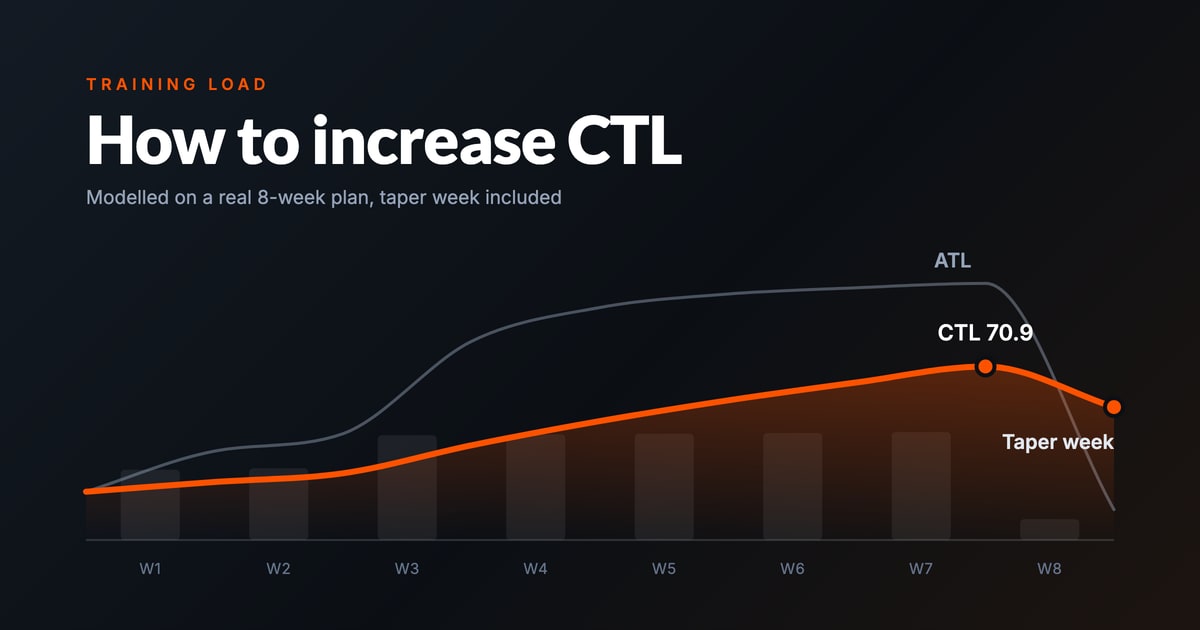
Do you ever feel like you've hit a wall on the bike?
You put in the miles, but you're not getting any faster on those climbs or stronger in your sprints.
I promise that the solution isn't always more time in the saddle.By adding targeted strength training to your routine, you can unlock a new level of power, endurance, and injury resistance.
In this guide, I’ll show you exactly why cycling strength training is a game-changer.
We will cover the key benefits, the most effective exercises, and how to structure your week to smash through performance plateaus. If your primary goal is fat loss, see our structured cycling for weight loss plan.
Why Strength Training Is Your Secret Weapon
You put in the miles, but those big climbs still feel like a grind. Your sprint lacks that final, decisive kick.This is a common frustration for cyclists. The solution is often found in the gym, not on the road.
Integrating targeted strength work into your routine unlocks a new level of power and resilience.
This guide will show you exactly why strength training is a non-negotiable part of the puzzle for you.
Strength training is a key piece of a well-rounded routine.
We explore this further in our guide to cross-training for cyclists.
I’ll break down how lifting translates directly to real-world results.
These include more watts on the pedals and better endurance for long rides.
You’ll also build a stronger defense against common cycling injuries.
The Real-World Benefits of Lifting for Cyclists
Let’s get specific about what you gain from cycling strength training. This isn't about getting bulky.It’s about becoming a more efficient, powerful, and durable cyclist.
You’ll feel these tangible benefits on every single ride.
You’ll see how stronger glutes and quads translate to more power.
This helps you accelerate faster and conquer steep grades with authority.
It’s the difference between grinding up a climb and attacking it.
1. Build Raw Power and On-Bike Speed
Strength training builds the raw force you can apply to the pedals.Think of your aerobic engine as the motor and your muscles as the transmission.
A stronger transmission transfers that power more effectively.
This means you produce more watts with less effort. Every single pedal stroke counts for more.
You’ll notice it most during sprints, short climbs, or when you need to close a gap. Strength training isn’t just an add-on; it’s a performance multiplier. The goal is to improve your power-to-weight ratio, making you a faster and more resilient rider without adding unnecessary mass. The strongest evidence to date is a 2026 meta-analysis of 17 studies. It found that heavy strength training improves cycling performance, and that the gain comes through efficiency and anaerobic power rather than through a bigger engine.
«Heavy strength training can improve cycling performance (i.e., time to exhaustion; time trial) in endurance cyclist. This improvement may be mainly due to an improvement in cycling efficiency and anaerobic power. These results occur without changes in VO2max, pVO2max, MMSS or anaerobic capacity. Nonetheless, the low certainty of evidence precludes robust recommendations regarding optimal implementation of heavy strength training.»
Llanos-Lagos A, Ramirez-Campillo R & Sáez de Villarreal E (2026). Heavy strength training effects on physiological determinants of endurance cyclist performance: a systematic review with meta-analysis. European Journal of Applied Physiology, 126:193–222.
Read that last sentence again, because it is the part most articles leave out. The pooled effect on efficiency and anaerobic power was significant, but VO2max did not move, and the authors themselves say the certainty of the evidence is low. Strength work is worth doing. It is not a shortcut to a higher ceiling.
2. Enhance Muscular Endurance and Fatigue Resistance
Long rides are won or lost in the final hours. That’s where muscular endurance comes in.This is your ability to resist fatigue over extended periods. Strength training is a game-changer here.
By strengthening the support muscles in your core, hips, and lower back, you maintain a more stable posture.
This cuts down on wasted energy from your upper body rocking. It allows more power to go directly into the pedals.
3. Create a More Injury-Resistant Body
Cycling is a repetitive motion sport. This is a perfect recipe for muscle imbalances and overuse injuries.The forward-flexed position often leads to tight hip flexors and a weak posterior chain. This includes your glutes and hamstrings.
A balanced cycling strength training program directly corrects these imbalances.
- Strengthens Underused Muscles: Moves like deadlifts and glute bridges wake up your posterior chain. This creates a more balanced and powerful pedal stroke.
- Improves Bone Density: Weight-bearing exercises stimulate bone growth. This makes your skeleton stronger and more resilient.
- Boosts Joint Stability: Building strength in the muscles around your knees and hips provides better support. This reduces the risk of common overuse injuries.
You don’t need to learn a dozen complex movements to build a solid foundation.
The key is focusing on compound exercises.
These are big, efficient lifts that work multiple muscle groups at once.
These movements build the raw power you’ll feel on every single pedal stroke.
Top 5 Foundational Strength Exercises for Cyclists
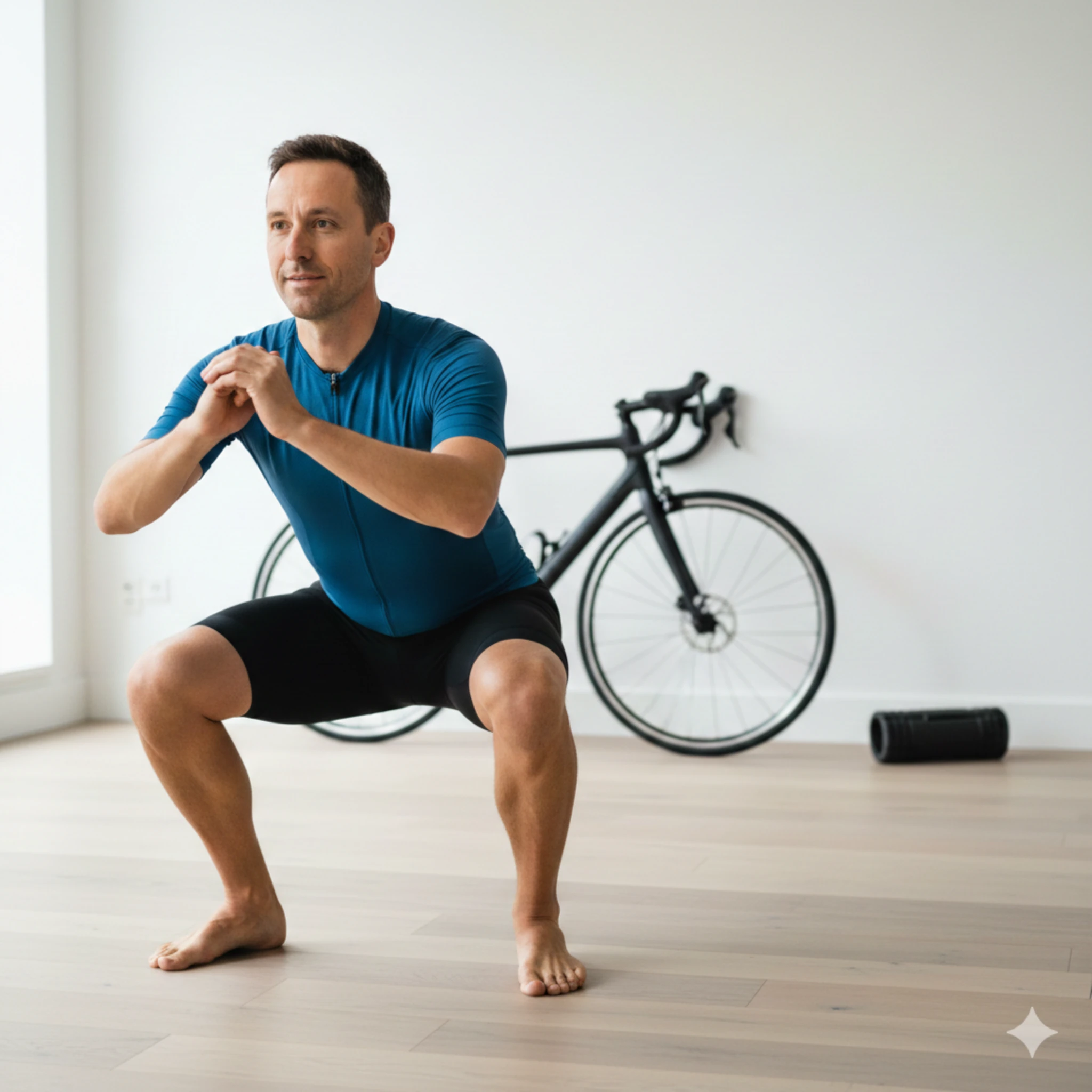
1. Squats
The squat exercise primarily targets the quadriceps, hamstrings, and glutes.It enhances lower-body strength, which is crucial for cycling as it improves pedal power and endurance.
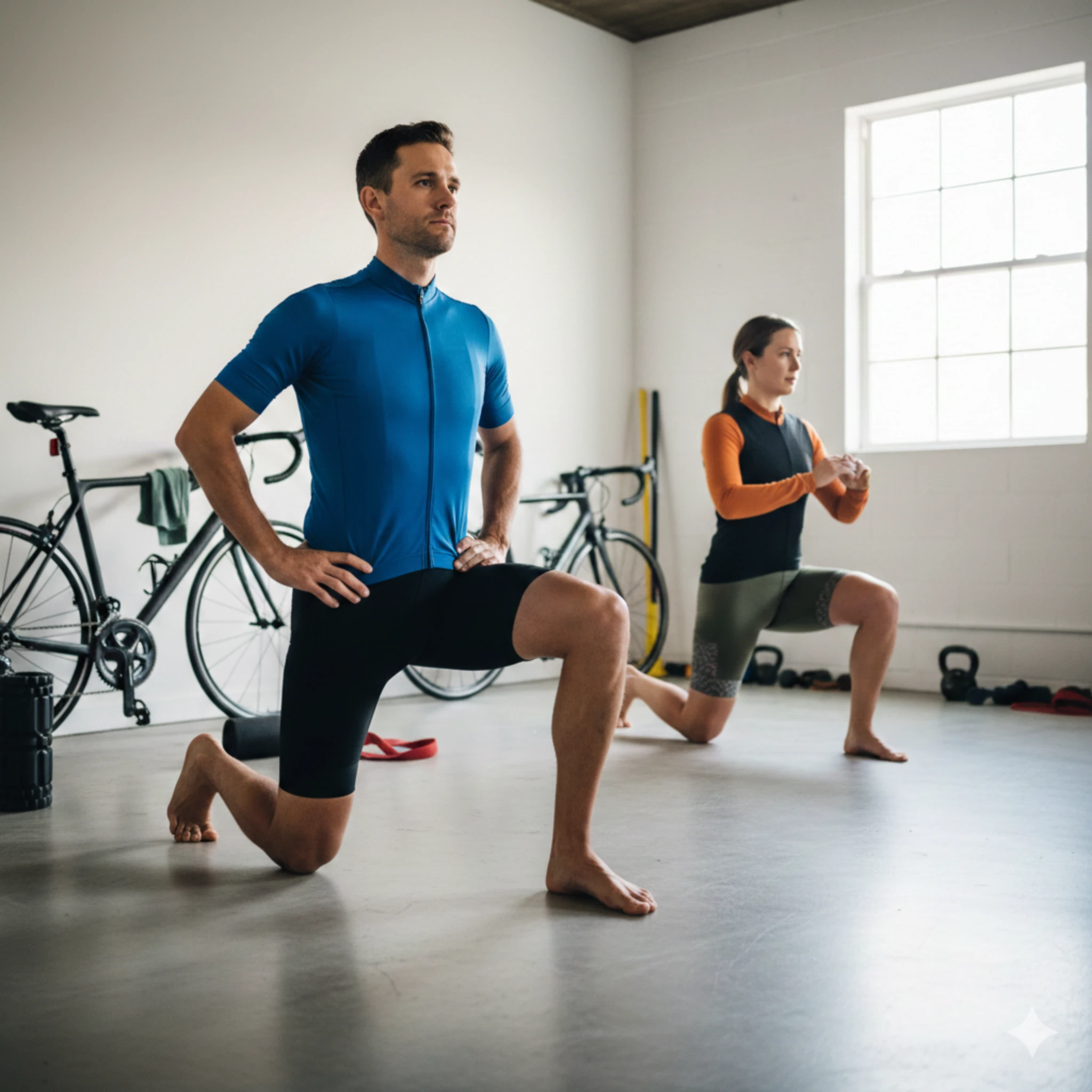
2. Lunges
Lunges work the quadriceps, hamstrings, glutes, and calves.This exercise helps in building balance and stability, essential for maintaining posture and control while cycling.
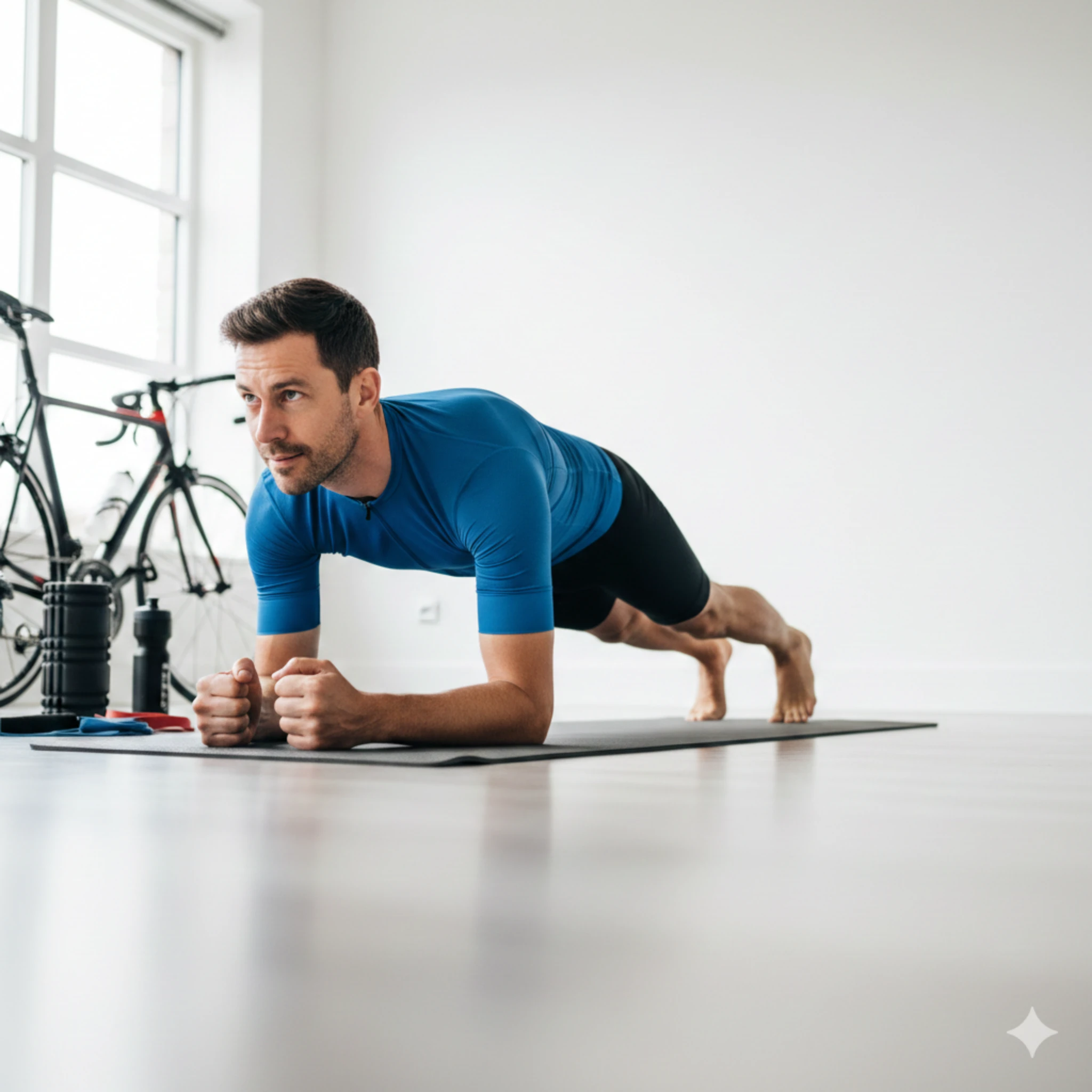
3. Planks
Planks engage the core muscles, including the abdominals and lower back.A strong core is vital for supporting the upper body during long rides and for maintaining good posture.
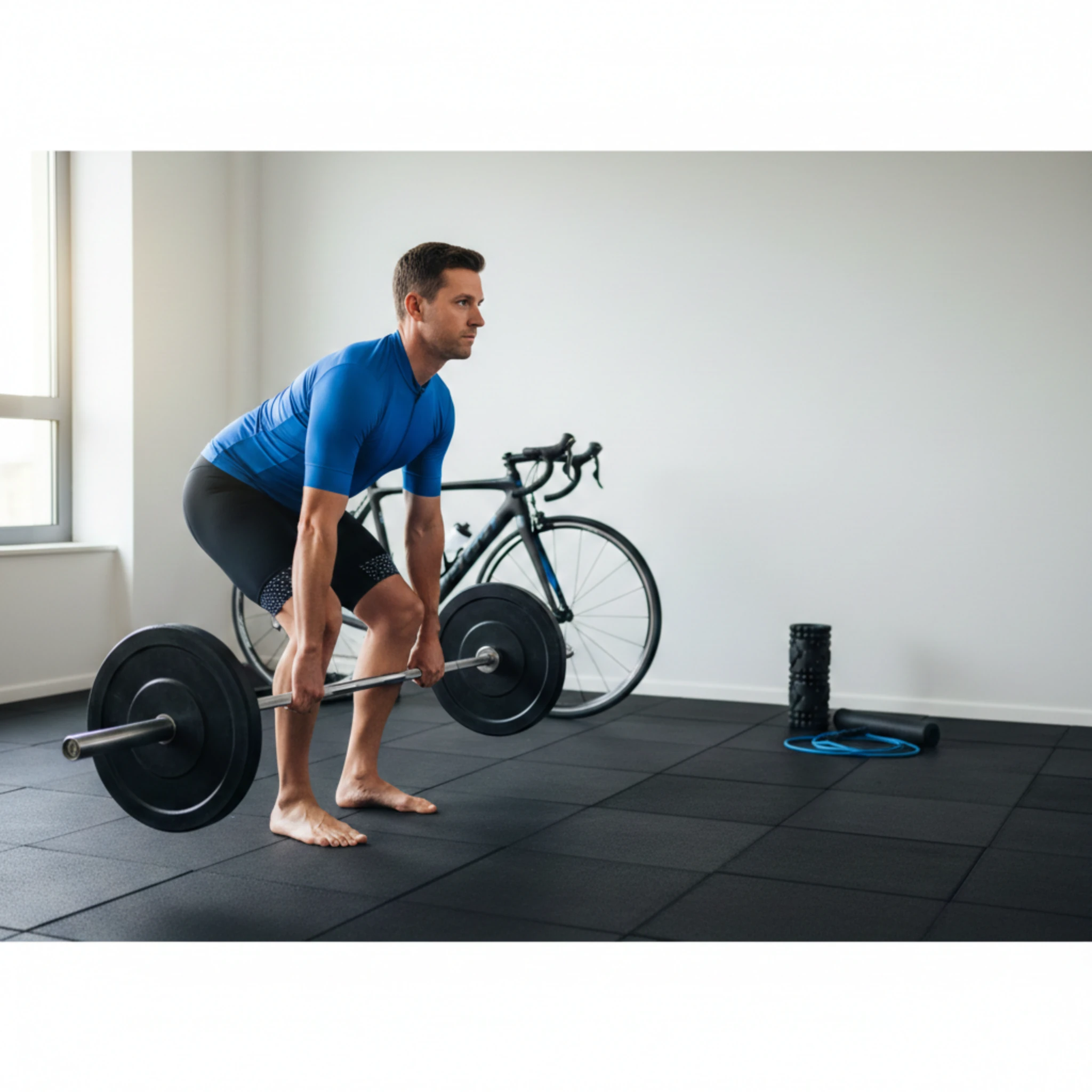
4. Deadlifts
Deadlifts target the lower back, glutes, and hamstrings.This exercise contributes to overall lower body strength and endurance, enhancing cycling performance.
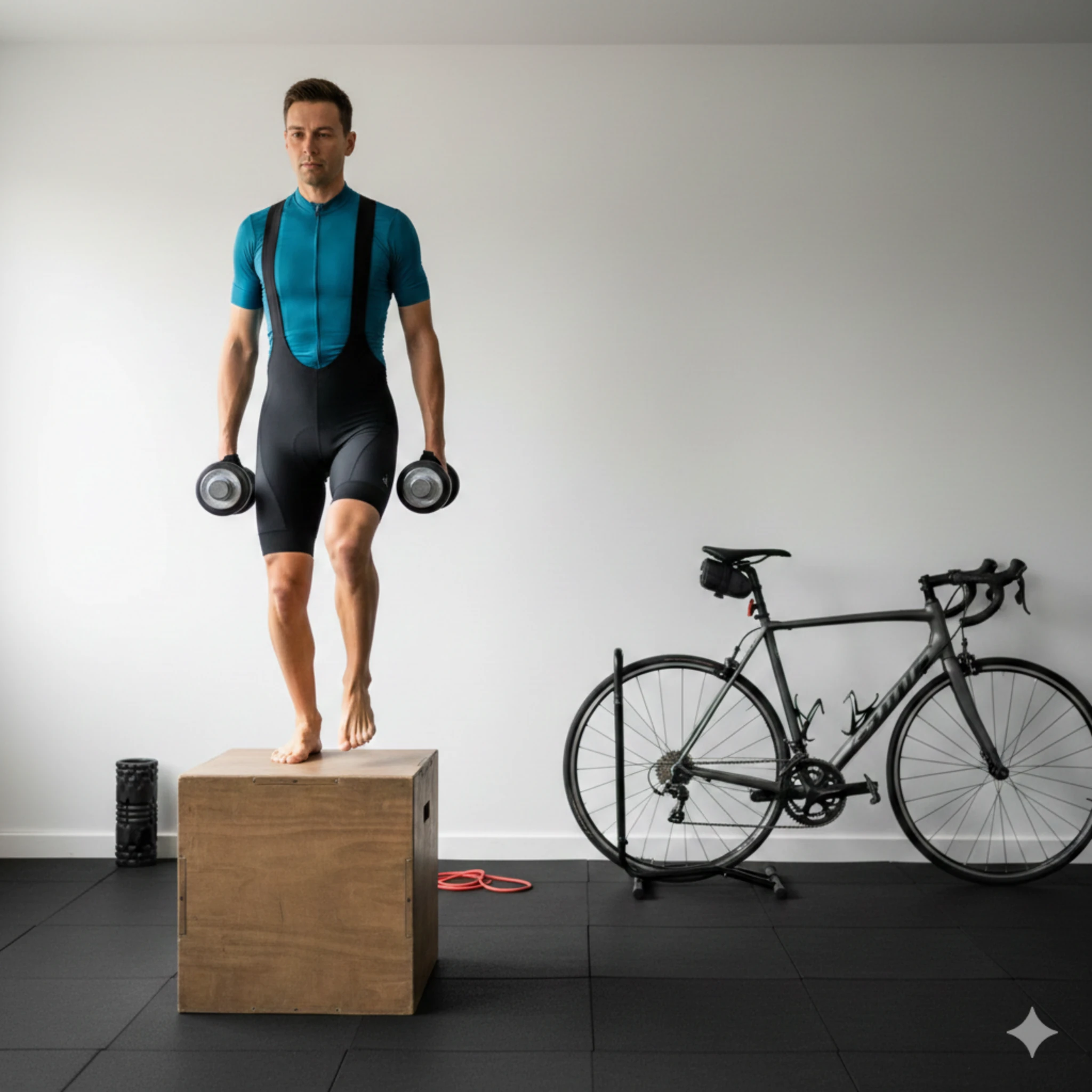
5. Step-Ups
Step-ups target the quadriceps, hamstrings, and glutes.They help improve leg strength, which is advantageous for effective and efficient cycling.
Mastering these five exercises will give you the biggest bang for your buck. They translate directly into a stronger, more resilient body on the bike.
Additional Strength Exercises for Cyclists
Power Your Pedals with Lower Body Lifts
Your legs are your engine. These exercises build the horsepower.They target your quads, glutes, and hamstrings. These are the primary movers in cycling that generate force for tough efforts.
A perfect place to start is the Goblet Squat. It’s a fantastic tool for learning how to squat correctly.
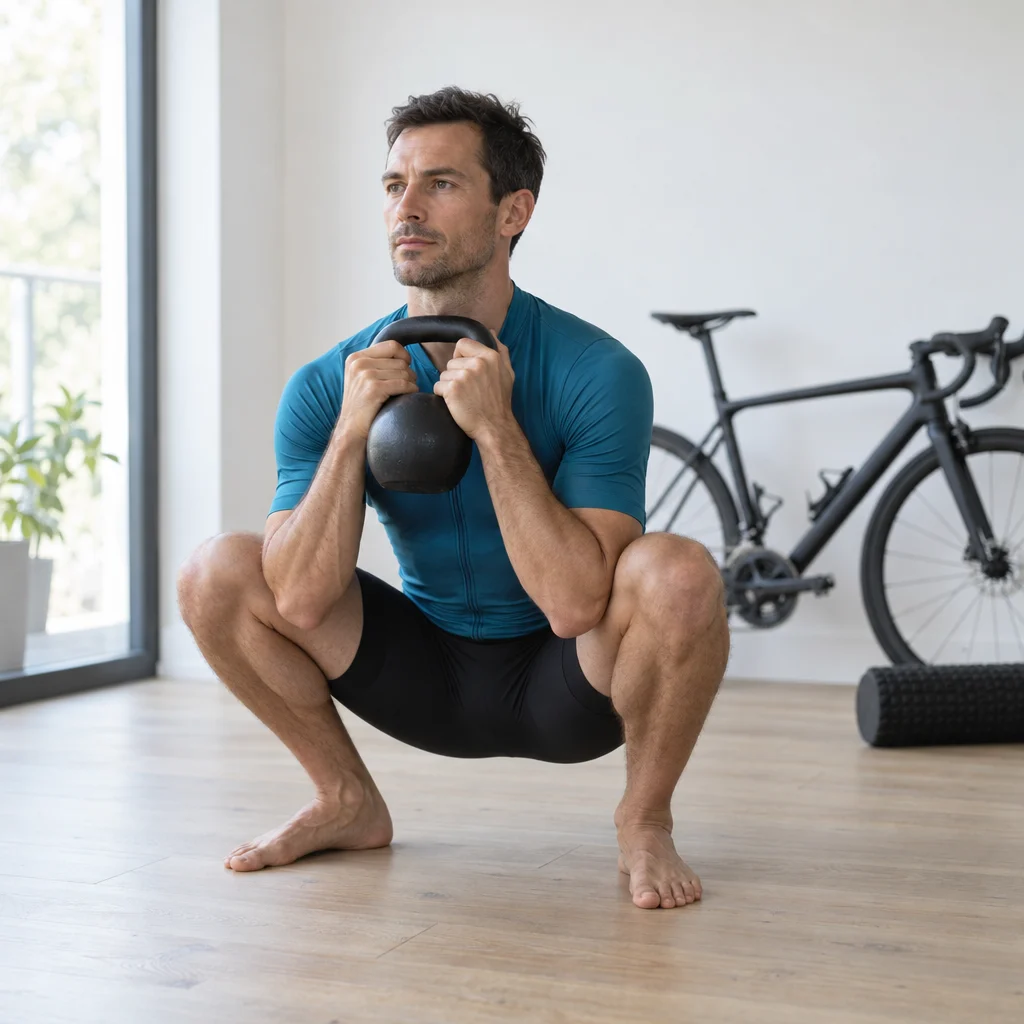
- How to do it: Hold one dumbbell vertically against your chest. Stand with your feet shoulder-width apart. Keeping your chest up, push your hips back and down. Go as low as you can while keeping your back straight, then drive through your heels to stand back up.
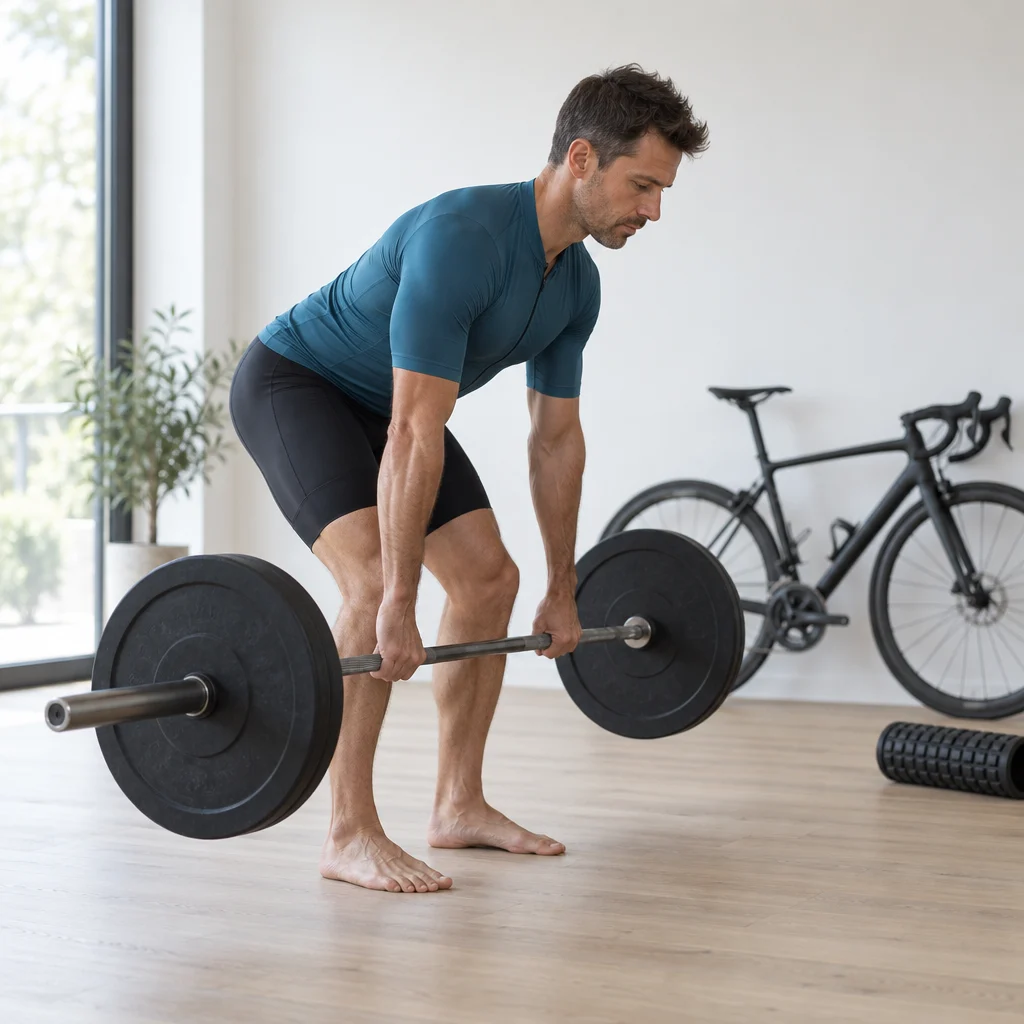 The goal isn't to lift the heaviest weight possible right away. Focus on mastering the movement patterns first. Flawless form prevents injury and ensures you're working the right muscles.
Correct Imbalances with Unilateral Work
Think about it: cycling is just a series of single-leg pushes. This is repeated thousands of times.This makes unilateral (single-leg) exercises incredibly important. They help fix natural strength imbalances between your dominant and non-dominant leg.
The Bulgarian Split Squat is king here. It’s a tough exercise that challenges your strength, balance, and mobility all at once.
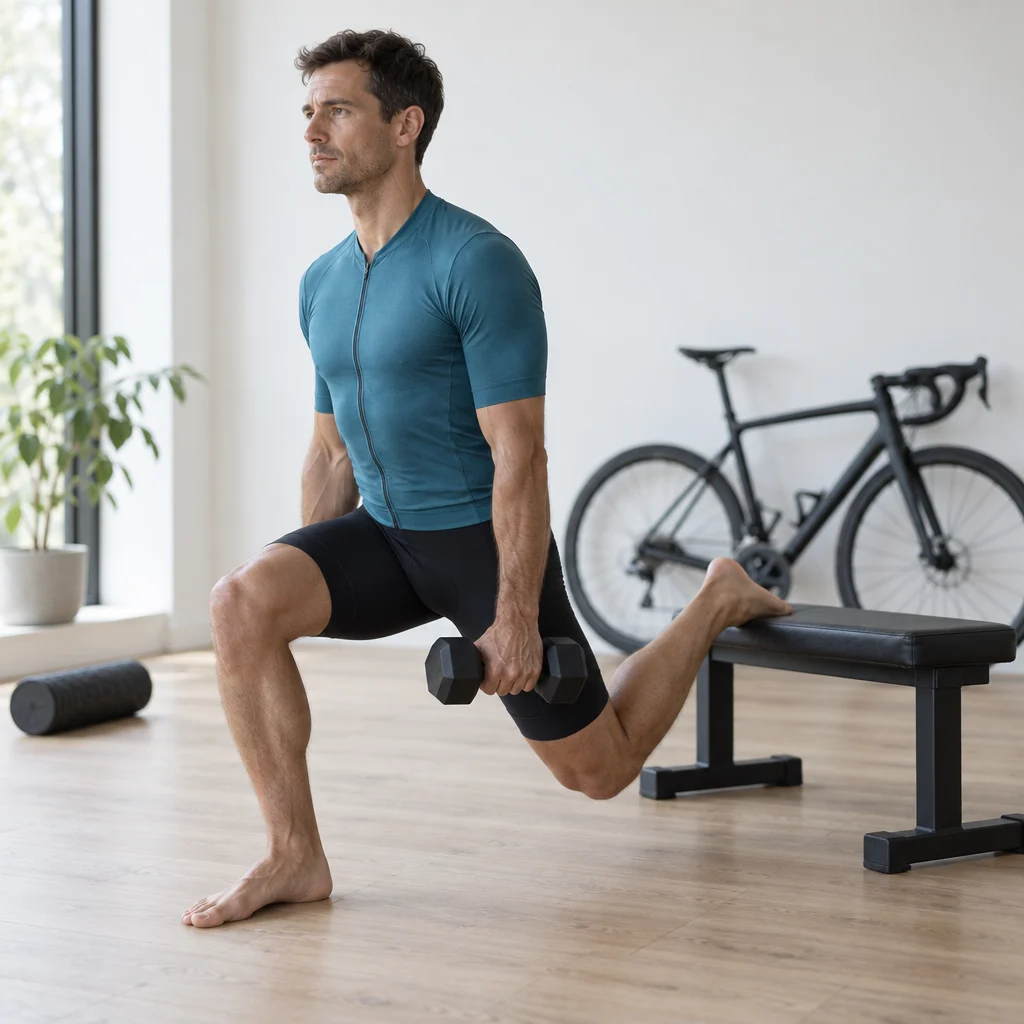
- How to do it: Stand a couple of feet in front of a bench. Place the top of one foot on the bench behind you. Keeping your torso upright, lower your hips straight down until your front thigh is about parallel to the floor. Drive hard through your front heel to return to the start.
Forge a Rock-Solid Core for Power Transfer
A strong core is your anchor. It’s the stable platform that transfers power from your legs to the pedals.Without it, energy gets wasted. Your lower back suffers, and your form falls apart on long rides.
Forget about endless crunches. You need exercises that build anti-rotation stability. The Plank is a great starting point.
For a bigger challenge, the Pallof Press is outstanding.
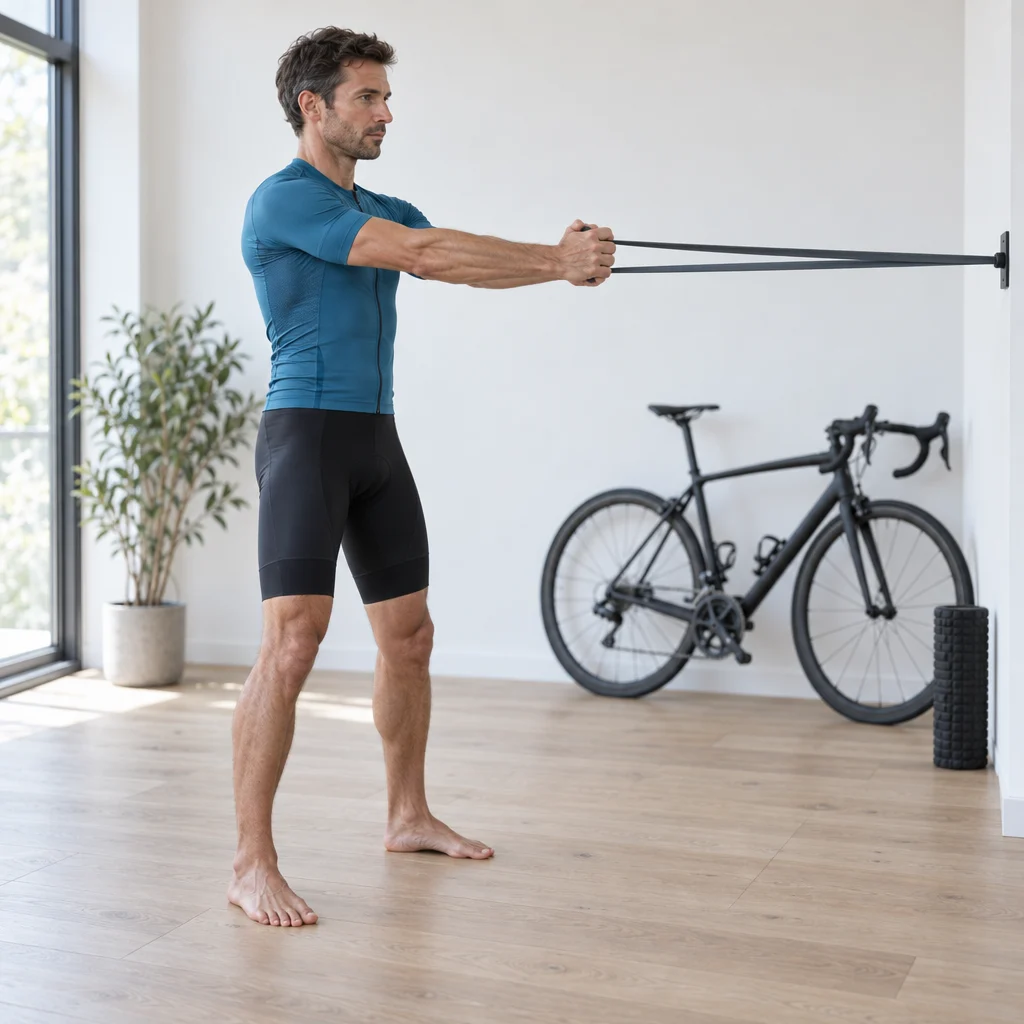
- How to do it: Stand sideways to a cable machine or resistance band anchored at chest height. Hold the handle with both hands at your chest. Step away to create tension. Press your hands straight out, fighting the pull to twist your body. Hold for a beat, then slowly bring your hands back.
How to Structure Your Training Week
Knowing the right exercises is one thing. Figuring out how to fit them into your packed life is the real challenge.A smart weekly structure for your cycling strength training ensures gym work supports your riding, not fights it.
One of the first questions is about timing. Should you lift on the same day as a hard ride?
A solid rule of thumb is to pair hard days together. It’s usually better to lift after your ride or on a completely separate day.
Plan for the Time-Crunched Cyclist
If you're juggling work, family, and time on the bike, efficiency is everything. For you, a two-day-per-week, full-body routine is the gold standard.This approach delivers the biggest bang for your buck. You can get these sessions done in under 45 minutes.
- Day 1 (e.g., Tuesday): Full Body Strength. Think exercises like Goblet Squats, Romanian Deadlifts, and Planks.
- Day 2 (e.g., Friday): Full Body Strength. Incorporate movements like Bulgarian Split Squats, Bent-Over Rows, and Pallof Presses.
For a deeper look at organizing your week, learn how a training microcycle works.
Plan for the Event-Focused Athlete
When you’re training for a specific race, your strength work needs to support your main goal. This is where you'll adjust what you’re doing in the gym based on the time of year.The off-season is your time to build maximal strength. You’ll be lifting heavier for lower reps to build a powerful foundation.
As you get closer to your competitive season, the focus shifts to maintenance. Your goal is simply to hold on to the strength you built. During your peak season, one well-structured, full-body strength session per week is often enough to maintain your gains without creating excess fatigue. The trend of combining indoor riding with strength work is a perfect example.
The global indoor cycling market is valued at USD 1.625 billion in 2024, according to Cognitive Market Research.
Mastering these foundational movements creates a rock-solid platform. They provide the power and stability you need on the bike. If mountain biking is your discipline, a mountain bike training plan that already integrates these strength sessions alongside your riding structure is the most efficient way to put this into practice.
Key Timing and Integration Tips
How you slot your strength sessions around your rides matters. Bad timing can lead to heavy legs and subpar workouts.Here are a few practical tips for you to keep in mind:
- Separate Hard Efforts: Leave at least one easy day between a heavy leg day and a high-intensity bike session.
- Lift After Riding: If you do both on the same day, make the ride your priority. Do your bike workout first, then hit the weights later on the day (not right away).
- Listen to Your Body: If you feel wrecked, don't be afraid to skip a gym session or lift lighter. Consistency over the long haul is what matters most.
The Four Phases of a Cycling Strength Plan
Most articles give you a list of exercises. The exercises are the easy part: the squat is a squat in January and in July. What changes across a season is the numbers, and that is what decides whether the gym makes you faster or just tired. Strength work for cyclists is periodised into four phases. Below is each one as we actually prescribe it, with the sets, reps, rest and RPE from a real session, not a generic template. Every session also includes a warm-up and a cool-down, left out here to keep the tables readable. The one number these tables cannot give you is your own load, because it depends on your max: the strength training calculator turns a set you already did into the working weight for each of these phases.| Phase | What it builds | Typical session |
|---|---|---|
| Anatomical adaptation | Movement quality and tissue tolerance | 48 min, RPE 6 |
| Maximum strength | Force production | 49 min, RPE 8, long rests |
| General strength | Holding the gains alongside riding | 50 min, RPE 6 to 7 |
| Maintenance | Keeping it when cycling load rises | 45 min, reduced volume |
Phase 1: Anatomical adaptation
Two to four weeks of teaching the movements and letting tendons and connective tissue catch up. Bodyweight and light loads, nothing near a limit. The point is to arrive at the heavy phase able to lift, not sore.| Exercise | Sets x reps | Rest | RPE |
|---|---|---|---|
| Goblet squat with light dumbbell or backpack | 3 x 10 | 60-75 s | 6 |
| Hip hinge Romanian deadlift with dumbbells or backpack | 3 x 10 | 60-75 s | 6 |
| Elevated push-up (hands on a bench, or a wall if needed) | 3 x 8 | 60 s | 7 |
| Band row, standing or seated | 3 x 12 | 60 s | 6 |
| Side plank, knees or feet | 3 x 20 s | 30-40 s | 6 |
| Dead bug | 3 x 8 | 30-40 s | 6 |
| Lateral band walk | 2 x 12 | 30-40 s | 6 |
| Band Pallof press | 2 x 10 | 30-40 s | 6 |
Main set of a real 48-minute session in this phase.
Phase 2: Maximum strength
This is the phase that produces the effect the meta-analysis found. Heavy loads, low reps, long rests. Four reps at RPE 8 is not a typo: the goal is force production, and volume here buys nothing but fatigue you have to carry onto the bike.| Exercise | Sets x reps | Rest | RPE |
|---|---|---|---|
| Barbell back squat | 4 x 4 | 2.5-3 min | 8 |
| Romanian deadlift, barbell or heavy dumbbells | 3 x 5 | 2-3 min | 8 |
| Walking lunge with dumbbells | 3 x 8 | 90 s | 7 |
| Hip thrust, barbell or machine | 3 x 6 | 2 min | 8 |
| Chest-supported row, machine or incline bench | 3 x 8 | 90 s | 7 |
| Dead bug | 3 x 8 | 60 s | 6 |
| Pallof press, cable | 3 x 10 | 60 s | 6 |
Main set of a real 49-minute session in this phase.
Phase 3: General strength
The maintainable middle, and the phase most riders spend most of their year in. Moderate loads, RPE 6 to 7, full body. It holds what the heavy phase built without competing with the bike for recovery.| Exercise | Sets x reps | Rest | RPE |
|---|---|---|---|
| Goblet squat, light dumbbell or kettlebell | 3 x 10 | 60-75 s | 6 |
| Romanian deadlift with dumbbells | 3 x 10 | 60-75 s | 6 |
| Reverse lunge, bodyweight or light dumbbells | 2 x 8 | 60 s | 6 |
| Hip thrust, bodyweight, shoulders on a bench | 3 x 12 | 60 s | 7 |
| Front plank | 3 x 30 s | 45-60 s | 6 |
| Dead bug | 3 x 8 | 45-60 s | 6 |
| Half-kneeling Pallof press with a band | 3 x 10 | 45-60 s | 6 |
| Bent-over row with dumbbells or a band | 3 x 12 | 60 s | 6 |
| Incline or regular push-up | 2 x 8 | 60 s | 6 |
Main set of a real 50-minute session in this phase.
Phase 4: Maintenance
When the cycling load rises, the gym is the first thing that should shrink, not the first thing to disappear. Same movement patterns, less volume, and equipment you can use at home so a busy week does not cost you the session.| Exercise | Sets x reps | Rest | RPE |
|---|---|---|---|
| Goblet squat with light dumbbell or backpack | 3 x 10 | 75-90 s | 7 |
| Romanian deadlift with dumbbells or backpack | 3 x 10 | 75-90 s | 7 |
| Reverse lunge, alternating legs | 3 x 8 | 60-75 s | 7 |
| Single-leg hip thrust, feet on a bench or sofa | 3 x 10 | 60-75 s | 7 |
| Half-kneeling single-arm row with a band | 3 x 12 | 60 s | 6 |
| Push-up, hands elevated if needed | 3 x 8 | 60 s | 7 |
| Dead bug | 3 x 8 | 45-60 s | 6 |
| Side plank, bent knees if needed | 2 x 30 s | 30-45 s | 6 |
Main set of a real 45-minute session in this phase.
Progressing Your Workouts to Avoid Plateaus
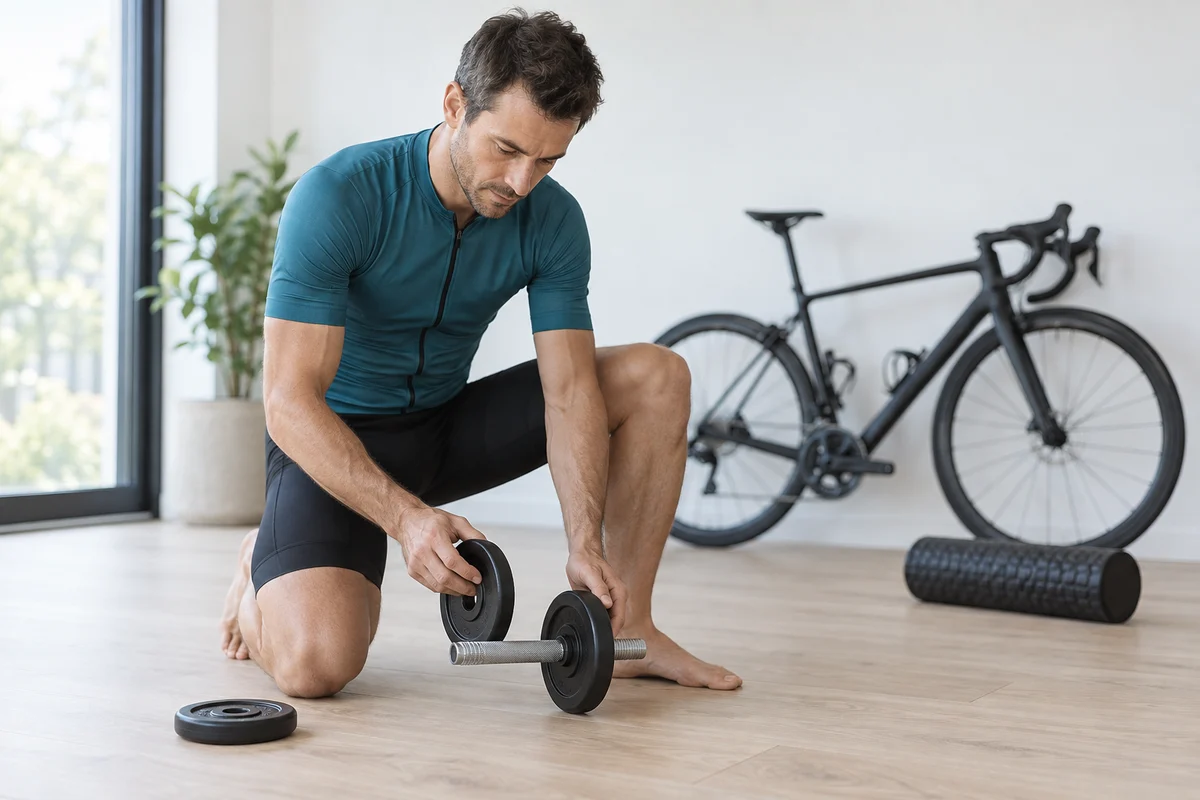
To keep getting stronger, your training can’t stay the same forever. Your body is incredibly good at adapting.
This means the workout that felt tough last month will eventually become your new normal. This is when you risk hitting a plateau.
The secret to breaking through is progressive overload. It just means you have to gradually increase the demand on your muscles over time.
Without that gentle push, your body has no reason to get stronger.
Smart Ways to Apply Progressive Overload
Just adding five pounds to the bar is the most obvious method. But it’s not always the best option for you.Your real goal is to create a new stimulus that forces adaptation.
Here are a few effective techniques you can use:
- Increase Repetitions: If you nailed 3 sets of 8 reps last week, aim for 3 sets of 10 reps this week with the same weight.
- Add Another Set: Instead of doing 3 sets of an exercise, try for 4. This bumps up your total training volume.
- Reduce Rest Time: Shaving your rest period from 90 seconds to 75 can make a huge difference.
- Improve Your Form: Slowing down the lowering phase of a lift can dramatically increase the challenge without adding weight.
Listening to Your Body: Productive Fatigue vs. Overtraining
The whole plan depends on telling good tired from bad tired. Productive fatigue is the heaviness that shows up after a solid session and clears in a day or two. Overtraining is when it stops clearing: performance drops, motivation goes with it, and no amount of willpower brings either back.
The difference is hard to feel in the moment and obvious in a log. Write down the load, the reps, how sore you were and how the next ride went, and the pattern shows up within a few weeks. That record is what tells you when to add weight and when to hold, which is the decision this whole article comes down to.